.svg)
.svg)


.svg)
.svg)
.svg)
Plan capacity on data, not experience
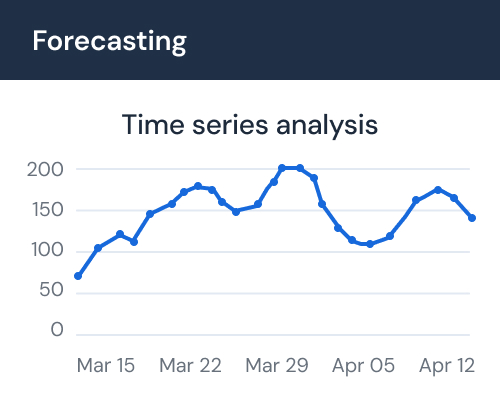
Replace fixed assumptions and experience-based estimates with AI models trained on your own delivery history. Give planners, carriers, and warehouse teams the numbers they need to align capacity before it matters.

Trusted by operators who own the delivery promise










Know what's coming and act before it arrives

Reduce fleet and carrier costs
Plan fleet and carrier capacity to predicted demand rather than fixed assumptions.

Grow volume without capacity shortfalls
Take on more demand by arranging capacity in advance rather than capping volumes to fixed fleet sizes.

Align carrier and warehouse teams
Replace last-minute carrier requests and reactive warehouse staffing with a predictable planning rhythm based on shared demand forecasts.
.svg)
Improve forecast accuracy over time
Improve accuracy and replace institutional knowledge with models that learn from your route and order history.
Take the guesswork out of capacity planning


Build forecasts on your own delivery data
Forecasting models train exclusively on your own route and order history, so predictions reflect your specific demand patterns rather than industry averages. Accuracy improves continuously as your operation grows and the system learns.

Build the data foundation your forecasts depend on
Accurate forecasting starts with well-structured logistics data. Mover's data scientists work directly with your team to organize, validate, and model your operational data so the platform can surface insights your operation can act on.

Customer stories

.svg)
.svg)
.svg)
%201.svg)

Additional resources
Frequently asked questions
It predicts how many routes and orders your operation will handle over a forward-looking planning window. Planners, carriers, and warehouse teams get the numbers they need to align capacity in advance rather than over-provisioning fleet or cap volume to a fixed fleet size.
Models train on your own route and order history to reflect your specific volume patterns. The more operational data, the more accurate the forecasts become.
The system applies standard models until your operation has generated sufficient delivery history to train a model specific to your patterns. Accuracy improves as your data grows.
The planning window is configurable to match your operational and contractual requirements. The forecast range narrows as the planning date approaches, giving you a progressively more precise picture to align all stakeholders.
Yes. When multiple carriers are configured, forecasts can be split by carrier so each partner receives the demand numbers relevant to them.
Yes. Order volume forecasts give warehouse managers a forward-looking count to set picking capacity before the planning window opens, keeping transport and warehouse planning aligned.

CTA subtile example
Call to action banner title example
Lorem ipsum dolor sit amet, consectetur adipiscing elit, sed do eiusmod tempor.